Saturday, 28 February 2015

The rules for making a national museum in Canada.

Rule 1: Hire an expensive, internationally renowned architect to create a jarring, distinct, and ostentatious design to please architectural critics and hopefully win a prize.

Rule 2: for the love of God make sure you have a large grand hall that you can rent out to wedding groups and for diplomatic occasions. Remember just because you’re subsidized by 35 million people doesn't mean you can afford to get cheap.

Rule 3: have a grand entrance to allow the people bask in the glory of the design. Don't worry about putting anything really at all in the grand entrance, the aforementioned superiority of the architectural design will pummel the visitors submission.

Rule 4: This is really important, don't forget to include the actual exhibits in your museum. The public will spend exorbitant amounts of money to get into your museum, even though you’re a public institutions, so they will expect to learn a thing or two. Make sure to keep it as impressionistic as possible. Remember taxpayers aren't paying for specific facts.

Rule five: Be sure to refer to your national museum as  world class at every available opportunity.  If you don't, people might realize, I mean, er, suspect that your full shit.


Review:  When looking at the floor plan of the museum, if exhibits are a clump in the middle of everything else, instead of everything else a clump middle of the exhibits, you know you've done a good job. They only complain because they're jealous.

Thursday, 26 February 2015

Up and Down


Above: The Atlas 5A rocket being installed outside the Canada Science and Technology Museum in 1973.

Below: The same rocket being taken down, yesterday.


Credit for both photos belongs to the Lost Ottawa Facebook community.

Friday, 6 February 2015

Dioramas in Milan

Photo from here.

My family lived in Italy for a year when I was ten, and I used to love visiting the Museo Civico di Storia Naturale in Milan. One of the highlights is their terrific collection of nature dioramas, made by Valter Fogato and others.

Having grown up in Ottawa, I was used to dioramas of Canadian wildlife, but Milan had dioramas of creatures from all over the world.

I didn't take any pictures of the dioramas myself, but I've been able to find a bunch here and there on the web.

Photo from here.

You don't often see dioramas of animals running. Perhaps this is because one's first instinct would be to say that they wouldn't fit -- they need space to run around in. But of course, at any particular instant in its run cycle, the animal doesn't take up any more room than it does when it's standing still. The running poses add real dynamism to this diorama of two guanacos.

Photo from here.

I wish I had a better picture of this diorama of an aardvark attacking a termite mound (there's apparently an aardworf in the diorama as well). It takes place at night, which looks really neat; you don't often see that in dioramas either.

Photo from here.

I don't actually remember this diorama of barbary sheep and addax, but  I came across it while looking for pictures to use in this article. I love how they've incorporated a replica of Saharan giraffe rock art; it's a subtle reminder of human presence.

Photo from here.

This diorama of grizzly bears catching salmon does a great job of conveying a frenzy of activity.

Photo from here.

Many of the dioramas have two different species in them, like this one of a muskox and a caribou. This not only saves space, since one diorama can stand for two animals, but also gives the opportunity to depict interspecific behaviour.

Finally, here are a bunch more that I like, but don't have anything clever to say about:

Siberian tiger and sika deer. Photo from here.

Emu. Photo from here.

Narwhals and walrus. Photo from here.

Yak. Photo from here.

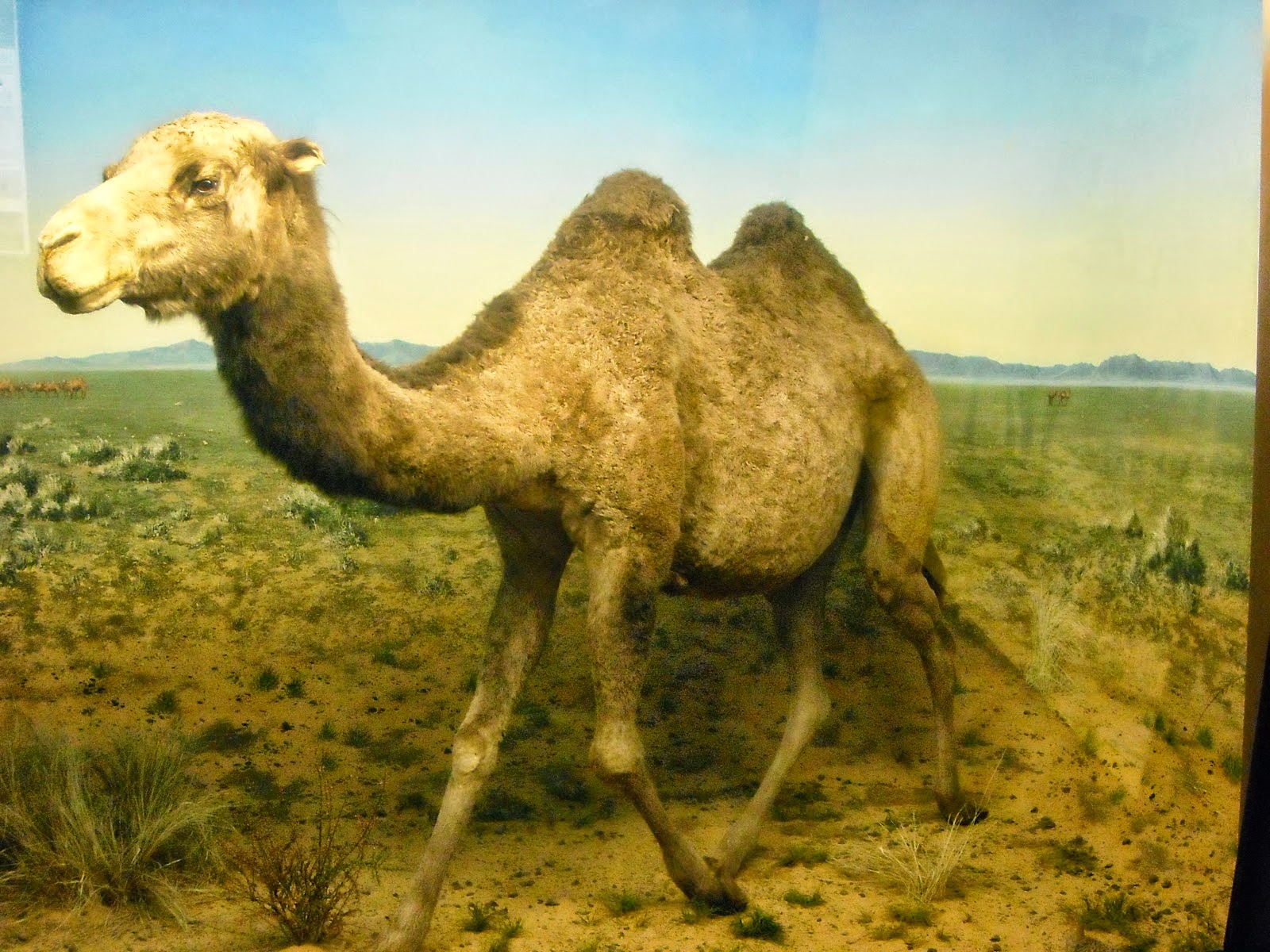
Bactrian camel. Photo from here.

Friday, 16 January 2015

"Life Through the Ages" Videos

You've got to love the National Film Board of Canada. Not only do they have an enormous online library of their films, all viewable for free, but they also take requests for what they should upload next.

Naturally, I requested that they upload the two videos that used to play in the Canadian Museum of Nature's old fossil gallery, Life Through the Ages. It took them a while to get to them, but they did!


Here's Origin of Life on Earth, which used to play in English and French at the very beginning of the exhibit. It was made in 1972, so I'm guessing it was part of the exhibit when it opened in 1974, and it lasted until the museum was closed for renovations in 2004.

Watching the film as a kid, I didn't really understand what I was seeing. But I loved (and still love) the haunting music, which really set the tone for the rest of the exhibit.


The second film is Extinction of the Dinosaurs, which played just after you came back upstairs from the dinosaur room. It illustrates the then-current idea that the dinosaurs died because of a nearby supernova.

This video wasn't on display for nearly as long. It was made in 1976, so must have been added to the exhibit later. And it was removed sometime around 1988, I'm guessing because of mounting evidence for the asteroid impact hypothesis.

In our modern age of super-realistic CGI dinosaurs (which I like!), I miss seeing stylized, impressionistic animated dinosaurs. I'd love to see a modern film with dinosaurs, accurate to what we know now, animated in this style.

Wednesday, 11 June 2014

Transition

The Canada Hall at the Canadian Museum of Civilization has the formidable task of fitting a thousand years of Canadian history into a 43,558 square foot exhibit.

One of the hardest parts must have been designing the transitions between one environmental reconstruction and the next. A transition has to feel continuous and not abrupt, but still convey a sense of change so that all the environments don't bleed into one. It also needs to save space wherever it can. The very best are so subtle that you don't even notice them.

My favourite transition is here, between the Ontario Street and the Canadian Prairies.


Did you notice what they did? I didn't until last year.

Take a look at the furniture store on the Ontario Street, and the railway car in the Prairies.


They're the same object! It's just decorated differently on each side.


You don't notice because you're looking at the CPR ticket office and the Govan train station. This interrupts your perception of the object. By the time you turn back around, you're in the next streetscape already, so you don't perceive its continuity.

And if you do happen to look at the side of the object, they've got you covered there too:


This panel on the driving of the last spike slows you down, once again distracting you from noticing the transition. (I especially like this view because it's Ontario on one side and Saskatchewan on the other.)

And by making one object stand for two, they save space too.

If you like this sort of thing, check out the post "The Awkward Transitions of Disneyland!" on the wonderfully detailed theme park blog Passport to Dreams Old & New. Theme parks were one of the reference points used by the Canada Hall's designers.

Friday, 6 June 2014

Pterosaurs in the Atrium

Speaking of the Canadian Museum of Nature's atrium: from 1999 to 2006, it was the home of two life-size sculptures of Pteranodon fighting over a fish.


I thought they were gone forever, but recently discovered that they now hang in a small, glass-walled building just behind the museum itself. I have no idea what this building is used for; does anybody know?


The pterosaurs were sculpted by Doug Watson (who also did the mammoth family in front of the museum) and Jean-Guy Auger. This page on Watson's website has a ton of information and photos of the sculpting process. You can even buy your own copies of the miniatures he made while planning it out!


I don't know why they didn't put these guys back in the atrium after the renovations. There's nothing in there now except the admissions desk.

It's also too bad the pterosaurs were never there at the same time as the totem poles. That would have looked awesome.

Thursday, 24 April 2014

Totem Poles in the Atrium

Before the Canadian Museum of History was called the Canadian Museum of History, it was called the Canadian Museum of Civilization. But before it was called the Canadian Museum of Civilization, it was called the National Museum of Man, and it shared the Victoria Memorial Museum Building with the Canadian Museum of Nature (then called the National Museum of Natural Sciences).

The two museums split up when I was four, so I only have vague memories of the way it used to be, and photographs from that era are nearly impossible to find. One thing I do remember is that there were totem poles in the atrium, but I can't remember any details about them.

But recently, two things happened. Firstly, I read A Museum for the Global Village, a fantastic book about the creation of the Museum of Civilization. It mentioned that among the many totem poles on display in the Grand Hall (a full-scale reconstruction of a composite Pacific Northwest Coast native village) were the very poles that had once stood in the VMMB's atrium. This should have been obvious -- it's not like they would throw them away! -- but it had never occurred to me.

The other thing that happened was that I finally found some pictures. These two photos come from the website of Edward J Cuhaci and Associates Architects Inc, the architectural firm that restored the VMMB in the late sixties:


They clearly show three poles in the atrium, and enabled me to identify exactly which poles they were. Here are photos of those poles as they are today, accompanied by descriptions excerpted from Raven's Village, a guide to the Grand Hall published in 1995.


House Waiting for Property Pole (Haida):

"The two figures at the base are Sus'an, mythical Sea Grizzly Bears. The lower one is wearing a tall hat with six potlatch rings, or skils, on it, and has a doorway through his abdomen. These two figures relate the myth about a young man who displeased his mother-in-law because she found him lazy. ... The son-in-law is depicted on the pole above Sea Grizzly Bear, wearing his Sea Grizzly Bear skin and clasping skils in his arms. ...

Three Watchmen are depicted at the top of the pole. The two small human figures on the sides are wearing skils, which were also worn by chiefs at potlatches. Each ring on the hat might have indicated the number of potlatches a chief had held. The central figure wears a hat sculpted in the shape of Killer Whale's fin. The figures appear to be watching -- either for guests or for enemies.

Below the Watchmen is Eagle with a hooked beak, and between his wings in Gunarh's wife. She is holding the dorsal fin of Killer Whale who, after her death, took her soul down to the country of whales. The myth describes how her husband tried to rescue her from the keepers of souls that live in the undersea world. ...

Below the woman's feet are the stylized fins and upturned tail of Killer Whale. Next is the face of the woman's husband, holding onto the head of Killer Whale. This pole dates from around 1875, and it once stood in front of a community house at Haina on an island near Skidegate."


Howkan Village Pole (Kaigani Haida):

"The pole depicts the story of the great flood. At the top is White Raven, as he was before he flew out of the smoke hole while stealing light from Sky Chief. Below are a series of skils with four humans clinging to the sides. The skils are on the head of Qingi, the supernatural father of White Raven, who was raising a totem pole when a great flood struck the world. As the water rose, his guests and relatives scrambled up the pole to save themselves from drowning. White Raven alighted on top of the pole, causing it to grow into a gigantic tree filled with the survivors of the flood. Below Qingi's extended tongue is Sculpin, and at the base of the pole is Qingi holding a human upside down between his bear-like claws. This pole was collected in early 1900 by Lord Bossom, who had it lashed to the deck of a ship and taken around Cape Horn to England. It was returned to Canada in 1969."


Kwaxsuu Pole (Nisga'a):

"[This] is a memorial pole that comes from the village of Angidah in the Nass River district and contains two grave boxes, although neither box actually contained human remains. The top box commemorates a chief who died in infancy, and has Grizzly Bear cub sitting on its lid. The lower box was put in place at the time when an important chief died; it has Wolf on its lid. Below the lower box is a face, representing a crest entitled Split Person. Grizzly Bear is next, holding a copper in his teeth, and at his feet is Bear cub, with his head pointing down. Another Grizzly Bear stands at the base of the pole, with a salmon in his mouth and a Bear cub between his legs. The Bear cub represents all the children of Grizzly Bear, and the faces on the Grizzly Bear's paws stand for the People of the Smoke Hole."


I also have this photo, of uncertain vintage:


It's a screenshot from this video about the more recent renovation of the Museum of Nature. The Kwaxsuu Pole and House Waiting for Property Pole can be seen on the left and right, but between them are two smaller poles.

Chief Qomoqua's Pole (Nuxalk):

"At the top of this pole is the blue face of the elusive supernatural Qomoqua, ruler of the undersea mythical creatures. On his head he wears Killer Whale ears that form a circular curl on each side. Beneath him is Owl; then comes Eagle, holding a disc in his claws. On the disc is the face of Chief Qomoqua, who commissioned the pole, and at the base is another image of his namesake, the supernatural Qomoqua. Legend says that people who are caught in whirlpools are carried down to Qomoqua's house below the sea."


Tallio Village Pole (Nuxalk):

"The disc represents Sun, with Eagle or Thunderbird perched on the top. Below the disc is the mythical Cannibal Bird, Giant Sharp Nose Man Eater at the North End of the World, whose ashes turned into mosquitoes when he was burned to death. Immediately below his down-turned lips is Beaver, and beneath him is the broad smiling face of an unidentified supernatural being. At the base is another face, with a sharp nose and a wide-open mouth, which was once used as the entrance to a house."


Here's a photo showing where all these poles are in the Grand Hall if you want to see them for yourself.


If you have any photos of the old Museum of Man, please let us know in the comments!

Sources:

MacDonald, G.F., and Alsford, S. 1989. A Museum for the Global Village: The Canadian Museum of Civilization. Canadian Museum of Civilization, Hull. 235 pp.

Ruddell, N. 1995. Raven's Village: The Myths, Arts and Traditions of Native People from the Pacific Northwest Coast: Guide to the Grand Hall, Canadian Museum of Civilization. Canadian Museum of Civilization, Hull. 53 pp.